Sunday, April 26, 2026

A Mighty Girl


There is very little specific to girls in this blog. Unfortunately, the blog never developed into a community. So the content mostly came from boy-mom me.

Not sure when A Mighty Girl started, but it's a great resource for positive books for girls, thematically divided.

There is a section for parents of children with disabilities which includes five books for parents with girls/children with autism.
There seems a lot to explore on this website, and I think many of the books would appeal to boys too. Worth a visit.

https://www.amightygirl.com/

- Spectrum Mom


Sunday, September 8, 2024

Over a Decade Later


Looking Back

This is a photo of my oldest son at about the time I started this blog.
He was reading, but not comprehending. At the time, I didn't put recognizable photos of him in the blog to protect his privacy. 

He's an adult now. Reading comprehension is still a challenge.
He has struggled through countless textbooks. He breaks them down into pieces, no magic strategies, but lots of well practiced ones. He  has managed to keep the information in his head long enough to pass his tests.

Just like in the past, he still enjoys joke books and (rhyming) poems.

Some thoughts from this time about that time.

1 Keep finding reading about topics your kid loves
2 Try to think of any interest in reading as success
3 Demand help from your kid's school

It's been years since I posted, but I pay a little each month to keep this blog available as a resource for anyone who might find it useful.

Enjoy the journey!

- Spectrum Mom

Saturday, February 20, 2021

NYT - Your Kids Aren't Too Old for Picture Books


I have long felt we should spend more time with picture books,

so this opinion piece by Pamela Paul caught my eye. Ms. Paul is

the author of  "How to Raise a Reader."

“My kid has outgrown picture books.”

I hear this often when enthusing about a new picture book and offering to pass one along to a friend. It’s the kind of thing parents will say with a certain amount of pride because of what it implies: My child is now reading independently and no longer requires the crutch of pictures. Just as he once relinquished the binky, he has moved on.

I hear this and I think, “Poor kid,” and also, “Poor parent.” Nobody moves on from picture books. At least, nobody should.

For the full piece click here


Saturday, May 2, 2020

Free Comic Book Day 2020

TODAY is FREE COMIC BOOK DAY


Except, of course it isn't.

The event has been postponed until later this Summer.
Will comic book stores still be here?

I don't know. Some will probably have to close. Maybe
to open up again, maybe not. They are usually crowded little
places on the margins or great big places full of everything
pop culture. I hope they will find a way to survive.

Comics remain a great way for visually oriented kids
to connect with stories, and the comic books themselves 
are not in quarantine.

Here's a link to some comics especially created for the younger/younger at heart set.

The Power Rangers have never gone away, and here comes the pink ranger to save the day!
Personally, Power Ranger popularity baffles me, but the art looks good, if busy. You be the judge.


DC offers up more girl power with a perplexing title about 
a school competition:


Um, okay.


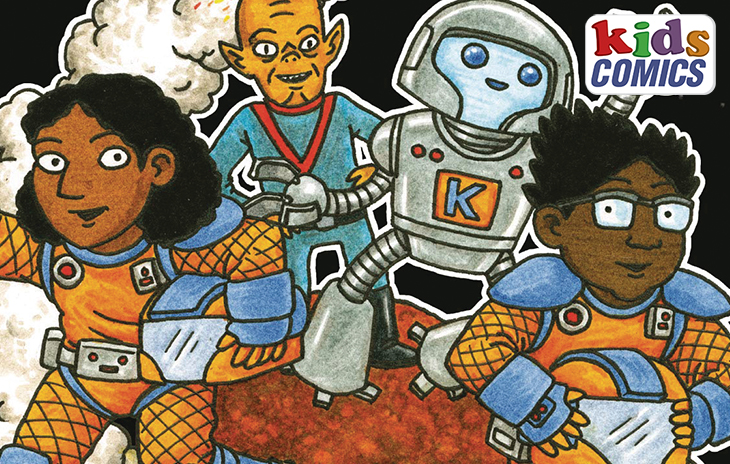
Sonic and Once Upon a Space-Time (featured at the top of this post) seem the sunniest titles of the bunch, and perhaps the ones with the most appeal to boys.

Once Upon a Space-Time is
an entry from the creators of Jedi Academy.

Rounding out the group is Disney Villains with a story featuring Ursula - so if your favorite reader with autism is a Disney fan,
they've got you covered.

For more about these titles and others, here's the link to the original article again.

Remember there's probably a comic book, maybe old, 
maybe new, with whatever tv show, cartoon, or movie you or 
your favorite reader enjoys. 

This may be a good time
to reach out to that local comic book store and see if they're 
delivering.

Happy Reading! 
We are #togetherapart
SpectrumMom

Thursday, March 26, 2020

Get Fuzzy - As Described by My 17 Year Old


Two Years Ago

I asked my 17 year old son to tell me about what he had been 
reading. As you can see below, he didn't describe it
in a book review type way, so I didn't post it.

But  -
it might be useful for others to see his process.
So here it is. My son's words are in blue.

"What have you been reading?"

"It's a comic strip. The Get Fuzzy book that I got for Christmas is "Scrum Bums."
In one of the parts of the book, Rob reads a book. He says it's about a guy that dies in the Louvre. Satchel the dog says, "Wait, he dies in the loo?" Bucky Katt adds, "He must have eaten some bad shellfish." Rob replies, "No, the louvre." Bucky says, "Louver, he was killed by a window treatment?"     
Rob says, "It's a museum, Bucky." "

Tuesday, March 24, 2020

Social Stories for a Pandemic

Covid-19 is here, and we need to tell our children about it.
Children with autism may have more anxieties about the virus, or find the disease harder to understand than children not on the spectrum.*

Fortunately, we have social stories.
Here is a link to one from Green Mountain Self Advocates
about what Covid-19 is:
Plain-Language-Information-on-Coronavirus.pdf

Here is another from Carol Gray:
https://carolgraysocialstories.com/wp-content/uploads/2020/03/Pandemics-and-the-Coronavirus.pdf

Social Distancing is vitally important right now, but may be
very confusing. Tennessee Disability Pathfinder shares this
story from Easter Seals Chicago to help explain the concept:
https://vkc.vumc.org/assets/files/resources/Social%20Distancing%20Social%20Story.pdf

Change social stories to suit your child. Use fewer words 
if that works better. 


Of course, you and your reader can create your own.
If you have the time, it may even be a fun project to
make your own Quarantine Time book with photos
and captions about your family's experiences in
this extraordinary time.

Stay safe.

- Spectrum Mom

*Many children without autism are also having a difficult time.
Social stories may be useful for them as well.

Friday, April 26, 2019

Free Comic Book Day May 4


Free Comic Book Day is almost here!

Every year on the first Saturday in May, the comic book world gifts us with fun, weird, delightful and sometimes horrifying comic books. None are designed for readers with autism, but many
may have great appeal for neurodiverse readers.

The comic books to be given away this year cover an astounding  range of popular culture.
If you're into Pokemon, Minecraft, or Dr. Who, 
there's a comic for you.
If you remember British funnies, or Little Lulu,
there's a comic for you.

Since many kids with autism have special interests like anime (My Hero Academia) Disney (Disney Descendants, Incredibles 2),  or Teenage Mutant Ninja Turtles, comic books can tap into that and give them a reason to read.


Younger and younger at heart readers may enjoy Go Fish,  A Sheets Story, and Gillbert.

This year FCBD is also Star Wars Day, "May the Fourth be with you" as you look for this year's Star Wars comic book.

Perhaps your reader's passion is  - comic books? That's well covered with Catwoman, Spiderman, and The Avengers - not to mention some less well known caped crusaders - Hope or Dragonflyman anyone?

Not all free comic books are available at every location, but
most comic book stores should have a good selection. Remember, choose carefully.
Some comic books are gory, sexual or both. Riverdale is now an emo teen hang, just like the tv show. But there's plenty of great stuff. Whether you/your reader want silly jokes, save the world action, or a sweet story, you'll probably find it on FCBD 2019. 

Here is a Super link to all the fun:
https://freecomicbookday.com

Friday, December 21, 2018

Someone Else's Ideas for Gifts

Happy Holidays!

I wish you the brightest of holidays with the happiest of New Years.

Alas, still no time to blog, so here's a link to a monetized site with a few more ideas if you're still shopping to bring joy to your very wonderful family. Be aware items are sponsored and the site uses cookies (and not the leave out for Santa kind).

From "Growing Hands On Kids"


Wednesday, May 2, 2018

Free Comic Book Day 2018

The First Saturday in May means .  .  .
FREE COMIC BOOK DAY!

Usually I have a few recommendations, but I am unsure which titles have clear story lines this year. If you or your kid have trouble with cluttered visuals/picture storytelling - I've made a few guesses.

Fifty titles this year, but remember not every store will have them all and popular titles may go quickly.
For the younger set there will be Adventure Time, Disney Princess Ariel, Invader Zim, Sparks!, Dr. Who, and Bongo Free for All
  (Simpsons stories) as well as many other titles. Judging by past books, Dr. Who, Ariel, Star Wars and Howard Lovecraft's Big Book of Summer Fun will probably offer clear storytelling. Also,
 comic book stores (hooray for comic book stores!) often
put out a wide variety of comics to give away from previous
years and other sources, so you should be able to find
something fun and appropriate.

If you haven't been around comics in a while, be aware they
can get very dark if intended for teen/mature readers. Archie, Betty, and Veronica act very differently in a Riverdale comic - recommended for teens and up.
There are only four of the fifty rated mature - you may want to give those a miss because of nudity and language.

For more information and to find a participating store near you,

Wednesday, March 21, 2018

The End of (High School) English

Ever since Third Grade when my son's teacher and the school staff revealed
1) my son didn't understand what he was reading 
2) they had no plans to help him improve
he's fought through the battlefield of English class with whatever poor weapons we could give him.
Currently he has an extraordinary, gifted tutor and a helpful, experienced teacher.
Together they face the last battle: Senior English

Beowulf
Canterbury Tales
Macbeth 

For a reader who still prefers Dr. Seuss, this reading list strikes me as mildly insane. But if he is to graduate with a regular diploma, (which I also have doubts about) to Chaucer and Shakespeare he must go.

Since his great tutor started, I only help once in a blue moon. He continues to be more interested in the sound of words than the meaning of sentences. As for narrative and subtext - 
let's just say his tutor needs to be the genius she is.
About The Canterbury Tales he remembers "When in April the sweet showers fall" and the titles The Pardoner and The Wife of Bath  
but when I ask what happened in the stories, he says 
"I forgot." (They studied it around Thanksgiving)

About Beowulf he says, "Did he ever have a battle with Grendel?"
(started this in September I think).

He's currently reading Macbeth, and remembers a fair amount, only slightly muddled:
"Macbeth is supposed to kill King Duncan in order to become Thane of Cawdor and King hereafter.  Macbeth's sidekick Banquo doesn't like it. He says Macbeth cheated to win those titles. Macbeth decides to kill Banquo and his son Fleance. Banquo dies but Fleance. Wait, he tells the murderers to kill Banquo and his son. The witches Macbeth will not die except at the hands of somebody who was not born of woman. They also say that the forest will move to Dunsinane hill. The forest does move. And Macduff says that he was not born of woman, but that he was untimely ripped from his mother's womb or something so Macbeth tries to deny the prophecy but he can't. And therefore he dies."

To get the regular ed diploma, you take the regular ed classes. 
I have more questions than answers about what all that means
and whether it makes sense for every student. 

What about you? What is your experience as student, parent, guardian, teacher, etc.?

Spectrum Mom


Wednesday, March 14, 2018

Editing Emotions

Little Critter by Mercer Mayer
Parenting Works posted an edited Little Critter page that went viral.
The original page read "I wanted to cry, but I didn't. I was brave instead."
The edit read "I wanted to cry, so I did! I was brave and sad."
While many commenters embraced the thoughtfulness of the message, others questioned why you would pick a book 
you have to edit before you can read it.
As a mother, I'm all about giving my kids the best emotional grounding I can. As a reader and a writer I am less sympathetic to those changing the words. Write your own books.
It takes forever to get the words just right.

This particular edit is sweet, but I think would confuse kids, 
especially some with autism who are only just learning what "brave" means. 

By all means, let your kids know it is okay to cry. And perhaps choose another book, because this one tells a different story about how sometimes we feel like we have to not cry.

The educator who writes Parenting Works explained that this
was one of her childhood favorites, and that she lacks the time
to bring just the right library books home. Instead she edits her own book collection. While I admire her dedication, her calm intelligence, and her emotional understanding, I don't really get why that is better than talking about the ideas in the book (after all, Little Critter is crying in the picture. Why not ask, "Why do you think Little Critter says he didn't cry?") or reading a book that fits her ideal of emotional intelligence.

Yet there's an idea in this post for all of us trying to connect our kids with books. Judicious edits may help avoid problems or improve messages. With the Froggy books I edited out the rudeness as much as possible. If a book is almost perfect for your child, what's wrong with a little tweak? But I still prefer judicious selection of books to editing the text. Not only are you reading what a gifted author wrote (and with so many wonderful books in the world, why bother with anything less?), you also avoid having your hyperlexic detail oriented child with autism obsess over why you changed the words. 


Here's a link to the Little Critter page edited by Parenting Works and featured in Elevating Child Care.

Spectrum Mom

Wednesday, May 17, 2017

Magazines - More RIppable Reads

 
 Last week I found a box in the basement that critters
(mice judging by their handiwork - pawdiwork?)
clawed up pretty well. 
Two Spider magazines survived the wreckage. I
brought them to the carport, mostly because of a cute
polar bear paper doll I thought a friend's kid would
like.
Then my oldest boy saw them. He's sixteen now (must
update the profile). I've tried to clear a lot of old mags
out of his room. So instead of taking it to his room,
he stands over the magazines in the carport and reads
them there.
It has not occurred to him to bring them in, and I won't 
suggest it. He is immensely curious as to where they came
from and if there are more. He remembers all the ones he
read and used to get fairly obsessed with keeping track of them,
an impossible task because very few kept their covers more than a week. 
Without being actively destructive, he's very hard on
reading materials. He reads them on the floor or on the bed, and usually steps on them a lot without noticing.
While searching for a good image for this post I found there's a deep discount on Spider - here's the link  
https://shop.cricketmedia.com/spider-magazine-special-offer?utm_source=bing&utm_medium=cpc&utm_campaign=Bing-Brand-CM
Spider contains a mix of stories, poems and activities, often a rebus
(my son remembers those) or a recipe.
Ladybug magazine (simpler stories and poems) usually has a song. 


Wednesday, May 10, 2017

Disposable Reading

Last Saturday was Free Comic Book Day. 
If you missed it, schedule a reminder for the first Saturday of May 2018. In the meantime, you can still go to a comic book store.
If your reader is hard on books but does not eat paper, 
old comic books may be a great choice.
The larger comic book stores have tons of old kid friendly comics priced low enough that you can let kids read, so long as you can handle the three Rs:
Read
Rip
Recycle 
I've already rescued my boy's comics from being sat on, and I know they'll soon
be shredded. 
He had trouble choosing. After fifteen minutes he had one comic book, Shrek.
I chose Bongo (The Simpsons) for him, and his brother picked up Scooby Doo. 
He looked at them right away in the car, but not again till I suggested he
read them this evening. So far, he's mainly pleased that Scooby Doo meets a
Man-Bat.
The thing about comics is, if it's in popular culture there's probably a comic
for it. So if your kid has a favorite tv show or movie and you'd like some
reading material based on it, there's a good chance you can find a comic
and use the tie-in to entice your kid to read a little something.
And comics are little somethings - 32 pages and done.
Short can be good.


Monday, May 8, 2017

Curious Incident of the Dog in the Night Time Play


The stage adaptation of The Curious Incident of the Dog in the Night Time is powerful. It is also loud, confusing, and sensorily overwhelming. 

Ironically, I can't recommend it for people with processing issues 
such as the main character has. This is clearly deliberate, since the
staging puts us in Christopher's position. We have to cope with
an overwhelming amount of stimuli and try to make sense of what
is going on in a challenging environment.

The subject matter rules it out for most pre-teens in any case,
but the staging also proved too upsetting for the young adult with
sensory sensitivities in our group.  

The brilliant concept of having a light box stage that can swim with stars, show maps, or let characters draw in light on the walls sets the show apart. Audience members adjust quickly to conventions, but the designers seemed determined to constantly surprise and challenge viewers. I still have no clear idea of the significance of the light up boxes the cast moved around the stage - but they looked great. The almost circus trick of Christopher curled up on fewer and fewer boxes was stunning, as were all the train sequences, the astronaut scene, and the maths (English usage).

I definitely found the play worthwhile and moving. I also sometimes wished I were home alone with a good book. If in fact my son went or goes through anything like this in the way he experiences the world, I am more impressed than ever at how much he accomplishes.

Last week I wrote that Christopher in the book did not seem like someone on the spectrum to me. Christopher in the play came much closer - the melt downs he has in the play especially. Theory of mind deficits are a bit more in evidence, still .  .  . being able
to say that you find people confusing is just so - well - not what I usually see or read about in (non-fictional) kids with autism. 


Kids with autism have seen and enjoyed this show. However,
if you or someone you are planning to bring has sensory issues, I would advise caution. You may want to wait for an autism friendly performance (there have been some). And remember, the dog in the book and in the play does nothing in the night-time because it is dead. The play starts with a horrible loud noise and a dead dog.


Friday, May 5, 2017

Free Comic Book Day!


Saturday, May 6, 2017 is Free Comic Book Day 
and it's going to be 
Miraculous!
 Seriously, that's one of the free comic books:
Miraculous, starring Lady Bug and Chat Noir.
Depending on your comic book store, your kid
can get everything from Simpsons
to Malika Warrior Queen.


I've written elsewhere in the blog about why I think comics
can be particularly helpful for readers with autism, today I'm just saying - go and enjoy!


For more on this special day, check out this link:
http://www.freecomicbookday.com/
or get the NPR spin here http://www.npr.org/sections/monkeysee/2017/05/05/525707610/a-guide-to-free-comic-book-day-2017-the-dont-misses-and-the-near-misses

Monday, May 1, 2017

Curious Incident of the Dog in the Nighttime

Curious Incident is a book, and now a play about a teenager named Christopher. Facts:
1) Mark Haddon is a novelist.
2) Mark Haddon does not have autism.
3) Mark Haddon was never a special education teacher.
4) Mark Haddon did not know anyone with autism well.
5) Mark Haddon did not research autism.
6) Mark Haddon didn't think of Christopher as having autism.
*
For some reason, Haddon misconceptions abound. A friend told me
#2 last night. Many people pushed this book at me and I read it
when first out, a very long time ago now. The misconceptions above shaped my reaction, which was - Christopher does not have autism. Now that I know the author agrees, I value this work of imagination more highly.
You may ask, as I ask, since autism is different in each individual, why do I feel so strongly that Christopher is not on the spectrum?
Basically, I don't recognize Christopher's blend of behaviors and analytical view of the world. Trouble with metaphors? Very usual. In depth analysis of said trouble? Highly un.
Yet whether you, like many, do find this a recognizable portrait of the gifts and challenges of autism, or like me, question it, the book remains a powerful example of what Haddon professedly wanted to show - an outsider struggling with the norms of a world he finds an uncomfortable place.
However you experience the central character, I think the book is a worthwhile read with many insights.
Next week, the play. 
*Source: http://markhaddon.com/aspergers-and-autism and his biography on this website.


Tuesday, October 4, 2016

Drawing Dot Dot Dot


A not so secret goal of many kids' coloring books is to 
get little kids comfortable holding that crayon in a 
tripod grasp, all ready to grab that pencil and start writing.
Drawing, of course, is even better for that purpose as kids 
form shapes - ready to begin/continue shaping letters.
For many children with autism, just getting the grip right
can take years. My sixteen year old still regresses.
While some may excel at art, others struggle with the basics.
So i can doodle Dots by Travis Foster gives a welcome head 
start to many.
The premise of this drawing book is simple. 
A simple drawing on one side of the page,
the outline for the same drawing on the other side
of the page, with space for variations.
For kids who need that model, this gives them a
chance to draw an interesting picture with visualization
help. Since visualization is another hurdle for many kids
with autism, this may really help.
What about you or your child? 
What kind of coloring/art books work best?


Sunday, September 18, 2016

Little Free Library

Step outside your home and look around.


Do you see a library?

No?
Are you sure?
Walk a few blocks and you
just might find a neighborhood
library close by.
Little Free Libraries have been
popping up for awhile, and I've
admired them from afar and online.
But until my neighbors built one,
I had no idea what a great resource
they could be.
It seems to yield endless knock knock
joke books - and if you've read this
blog often, you know how great that is for my son
with autism. Not to mention all the choices
for my younger son and myself.
Currently there are two picture books - 
Mind Your Manners B. B. Wolf and
Cockatoo, Too of which the first
seems educative and the second, fun,
with both being exceptionally suitable
for readers who might need a little 
extra help with cultural norms or might
have a special appreciation for word play.
A free little library offers a great chance for a reader
to make a choice among a limited selection of books.
And if you're into projects, you can make
your own. For more info, check here: 
https://littlefreelibrary.org/
How does your free little library grow? 

Saturday, September 17, 2016

Technical Difficulties

Contrary to my profile, my son with autism is 
now sixteen. He still struggles with 
comprehension. And I struggle with my
computer and blogger. Hence, no posts
in forever. Now and then I add to the
Facebook Page, mainly local events.
Reading Comprehension is a many-
faceted beast. Most of us don't realize
that. I sure didn't. For someone with 
autism, there can be many stumbling
blocks.
An early goal (age six maybe?) was
helping him differentiate between fact
and opinion. In reading, this is similar
to dividing texts into non-fiction and
fiction. This, of course, is the barest
beginning.
In an old post, I talked about having him
act out texts. At this point, this is more
distracting than helpful. He is fascinated
by the envelope of meaning. If spoken, by
rhythm, rhyme, and tone. If written, by 
syllable count, chapter and page number,
and word play (including rhymes, puns,
assonance, alliteration, etcetera). 
Meaning does not interest him.
His current tutor hopes to give him the 
authorial perspective - what does the author
want to do?
Since I find this somewhat dense going 
myself (is this passage meant to inform?
explain? entertain? why can't it be all
three?) I am unsure of my ability to
assist in this enterprise. But by all means,
if he will go there, let's go!

What about you? Are you a reader with
autism, or do you have a reader with autism
in your life? Do you have questions?
Answers?  

Tuesday, April 19, 2016

Reading Programs - Fast ForWord

I only just learned that Fast ForWord existed.
It seems to be computer based. 
Info from their website below.

Early Reading Programs
While reading problems vary for ages 4 to 7, the underlying source of difficulty is almost always phonological awareness, the target of our reading programs.
Protocol
Our early childhood reading programs help reading fundamentals, the cognitive and language skills required for reading fluency.
Elementary Age Reading Programs
Target: Fluency, the ability to read at natural language speed with prosody (natural speech emphasis). Fluency is important because it requires automatic, subconscious decoding, the foundational skill for reading comprehension.
Protocol
Elementary age children need at least 2-3 months on Fast ForWord Language v2 and Language to Reading v2, before graduating to our reading skills programs, which cover spelling, vocabulary, decoding, and reading comprehension.
Our elementary age reading programs have a computer-game feel — levels, points, prizes — and a self-paced design that together add up to an engaged student experience.
Middle School Reading Programs
Target: Comprehension (Literal). Reading difficulties often show up in later grades as the content gets progressively more challenging. This can be due to a lack of automaticity in decoding, but can also reflect weak vocabulary or delays in essential reading comprehension skills.
Protocol
Our middle school reading programs take students back to basics, building reading fluency and listening comprehension skills using Fast ForWord Literacy and Literacy Advanced. We then move students to the reading series — typically Reading Level 2, 3 and 4 — to build vocabulary, spelling and other reading comprehension skills.
High School Reading Programs
Target: Comprehension With Metacognition. If a student is a struggling reader at high school, it is generally up the parent to intervene — by this age, most schools assume students are proficient decoders, with the focus being on metacognition, self-regulated learning.
Protocol
Our reading programs for high school students start with fluency, vocabulary, spelling and comprehension and then train students to think actively while reading, the ultimate reading skill.
Teenagers start with Fast ForWord Literacy and Literacy Advanced. Most high school students complete at least two programs in our reading series, typically Reading Level 3 and Reading Level 5, which work on reading accuracy, making inferences from paragraphs, and metacognition skills as required for SAT, ACT and college level reading.

Logistics and Compliance
Our reading programs can be helpful before sitting ACT or SAT, although they do require consistent effort and attendance, a challenge for some high schoolers. Older students see results quickly, in 2-3 months in most cases.